Chemmy's Blog

chengming0916@outlook.com

1. K3s指定集群管理IP

在k3s.service中添加启动参数

1
--advertise-address=<192.168.x.x>

详细参考官方文档以及 K3s安装

查看当前Context

1
kubectl config current-context

2. 配置集群信息

查看context列表

1
kubectl config get-contexts

输出中带有*的Context表示当前活动的Context

切换到指定Context

1
2
3
4
5
kubectl config use-context <context_name>

# 示例:切换到dev-ctx
kubectl config use-context dev-ctx

在指定Context中执行命令,一般用于临时使用

1
2
3
4
kubectl  --context=<context_name> <exec_cmd>

# 示例:在dev-ctx下执行get pods
kubectl --context=dev-ctx get pods

3. 合并配置文件

在 Kubernetes 环境中,使用 kubectl 管理多个集群非常常见。通过配置 kubeconfig 文件,可以轻松切换和管理多个集群。以下是实现方法的详细步骤。

方法 1: 合并多个配置文件

  • 准备配置文件 假设已有两个集群的配置文件:_/.kube/config1_ 和 _/.kube/config2_。

  • 合并配置文件 使用以下命令将多个配置文件合并为一个:

KUBECONFIG=/.kube/config1:/.kube/config2 kubectl config view –merge –flatten > ~/.kube/config

  • 验证合并结果 查看合并后的配置:

kubectl config view

方法 2: 配置环境变量

  • 设置环境变量 将多个配置文件路径添加到 KUBECONFIG 环境变量中:

export KUBECONFIG=/.kube/config:/.kube/test-config

  • 验证配置 执行以下命令查看所有集群信息:

kubectl config get-contexts

方法 3: 手动编辑配置文件

  • 打开配置文件 编辑 ~/.kube/config 文件,将其他集群的 cluster_、_context 和 user 信息粘贴到现有配置中。

  • 格式示例

1
2
3
4
5
6
7
8
9
10
11
12
13
14
15
16
17
18
19
20
21
22
23
24
25
26
27
28
29
30
31
32
33
34
35
36

apiVersion: v1

clusters:

- cluster:

server: https://127.0.0.1:6443

name: cluster1

- cluster:

server: https://192.168.0.1:6443

name: cluster2

contexts:

- context:

cluster: cluster1

user: user1

name: context1

- context:

cluster: cluster2

user: user2

name: context2

current-context: context1

切换集群上下文

  • 查看当前上下文:

    1
    kubectl config current-context
  • 切换到其他上下文:

    1
    2

    kubectl config use-context <context_name>

    最佳实践

  • 使用合并或环境变量的方法更高效,避免手动编辑出错。

  • 定期备份 kubeconfig 文件,防止误操作导致数据丢失。

  • 确保每个集群的访问凭证和权限正确无误。

通过以上方法,您可以轻松管理多个 Kubernetes 集群,提高运维效率。

大家好!在 云原生 的世界里,和 Kubernetes 打交道是家常便饭。如果我们像我一样,需要同时管理多个 Kubernetes 集群——比如一个用于严谨发布的 生产环境 ,一个用于大胆实验的 测试环境 ,甚至还有本地开发环境——那么高效、安全地在它们之间切换就成了必备技能。

很多朋友(包括我自己有时也会!)可能会因为一段时间没用而忘记 kubectl 中那些用于切换配置的命令。别担心,这很正常!今天,我们就来系统地回顾一下 kubectl 配置管理的核心概念—— 上下文(Context) ,以及如何利用它在不同集群间自如切换。

核心概念:kubeconfig 文件与上下文(Context)

kubectl 的所有配置信息都存储在一个或多个 YAML 文件中,默认情况下是 $HOME/.kube/config 。这个文件我们通常称为 kubeconfig 文件。把它想象成我们的 Kubernetes “护照”,里面记录了我们能访问哪些集群,用什么身份访问。

一个 kubeconfig 文件通常包含三个主要部分:

  1. Clusters(集群) :定义了我们要连接的 Kubernetes 集群的信息,比如 API Server 的地址和集群的 CA 证书。
  2. Users(用户) :定义了访问集群所使用的凭证,可能是用户名/密码、Token 或客户端证书。
  3. Contexts(上下文) :这是连接 集群用户 的桥梁。一个 Context 定义了使用哪个 User 凭证去访问哪个 Cluster。

关键点: 我们可以通过切换 Context 来改变 kubectl 当前操作的目标集群和使用的身份。

管理 kubeconfig 的常用 kubectl config 命令

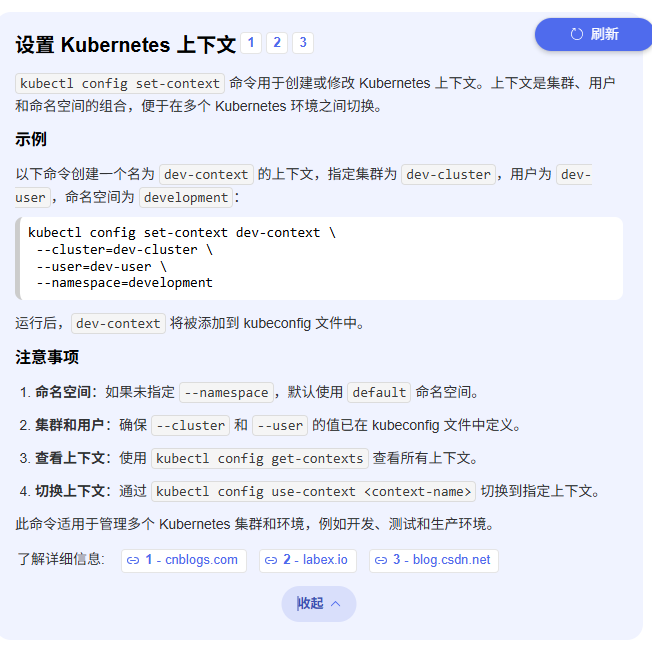
kubectl 提供了一套 config 子命令来帮助我们查看和管理 kubeconfig 文件。以下是几个最核心、最常用的命令:

1. 查看当前配置:kubectl config view

这个命令会显示我们当前的 kubeconfig 文件内容(或者合并后的内容,如果我们配置了多个文件)。它会隐藏敏感信息(如证书和 Token 的具体内容),非常适合快速检查配置概览。

1
2
kubectl config view
bash1

如果我们想看某个特定 Context 的详细信息,可以加上 --context 参数:

1
2
3
# 查看名为 'prod-cluster' 的 context 细节
kubectl config view --context=prod-cluster
bash12
2. 列出所有可用的上下文:kubectl config get-contexts

这是 最常用 的命令之一,它会列出我们在 kubeconfig 文件中定义的所有 Context。当前正在使用的 Context 会在名称前用星号 * 标记。

1
2
3
4
5
6
7
kubectl config get-contexts
# 输出示例:
# CURRENT NAME CLUSTER AUTHINFO NAMESPACE
# * test-cluster kubernetes-test user-test
# prod-cluster kubernetes-prod user-prod production
# docker-desktop docker-desktop docker-desktop
bash123456

从上面的输出可以清晰地看到:

  • 当前激活的 Context 是 test-cluster
  • 还有名为 prod-clusterdocker-desktop 的 Context 可供切换。
3. 查看当前使用的上下文:kubectl config current-context

如果我们只想快速确认当前 kubectl 命令会作用于哪个 Context(哪个集群),这个命令最直接:

1
2
3
4
kubectl config current-context
# 输出示例:
# test-cluster
bash123
4. 切换上下文:kubectl config use-context

这绝对是 核心中的核心 !当我们需要将 kubectl 的操作目标从一个集群切换到另一个集群时,就使用这个命令。

假设我们想从当前的 test-cluster 切换到 prod-cluster

1
2
3
4
kubectl config use-context prod-cluster
# 输出示例:
# Switched to context "prod-cluster".
bash123

切换成功后,我们可以再次使用 kubectl config current-contextkubectl config get-contexts 来验证当前上下文是否已更改。

1
2
3
4
5
6
7
8
9
10
11
kubectl config current-context
# 输出示例:
# prod-cluster

kubectl config get-contexts
# 输出示例:
# CURRENT NAME CLUSTER AUTHINFO NAMESPACE
# test-cluster kubernetes-test user-test
# * prod-cluster kubernetes-prod user-prod production
# docker-desktop docker-desktop docker-desktop
bash12345678910

现在,所有后续的 kubectl 命令(如 kubectl get pods, kubectl apply -f ... 等)都会默认发送到 prod-cluster 所定义的集群,并使用 user-prod 的身份进行认证。

实践场景:在生产和测试集群间切换

假设我们的 kubeconfig 文件中已经配置好了代表生产环境和 测试环境 的 Context,可能分别命名为 productiontesting

我们的日常操作流程可能是这样的:

  1. 检查当前在哪:
    1
    2
    kubectl config current-context
    bash1
    或者看列表:
    1
    2
    kubectl config get-contexts
    bash1
  2. 需要操作测试环境:
    1
    2
    3
    4
    5
    6
    kubectl config use-context testing
    # 验证一下(可选但推荐)
    kubectl config current-context
    # 现在可以对测试环境执行操作了
    kubectl get pods -n test-namespace
    bash12345
  3. 需要紧急处理生产环境问题:
    1
    2
    3
    4
    5
    6
    kubectl config use-context production
    # 验证一下
    kubectl config current-context
    # 操作生产环境(请务必小心!)
    kubectl get deployment -n critical-app
    bash12345
  4. 完成生产环境操作,切回测试环境继续工作:
    1
    2
    kubectl config use-context testing
    bash1

提升效率的小贴士

  1. 清晰命名 Context :给我们的 Context 起一个能清晰表明环境和用途的名字,比如 gke-prod-eu, eks-dev-us, local-minikube 等。避免使用模糊不清的名字。
  2. 使用 Shell 别名 :很多人喜欢为 kubectl 设置别名,比如 alias k=kubectl 。这样我们的命令可以更短: k config get-contexts, k config use-context my-context
  3. 考虑使用辅助工具 :社区有一些流行的小工具可以让我们更方便地切换 Context 和 Namespace,例如:
    • kubectx (用于切换 Context)
    • kubens (用于切换 Namespace)
      这些工具通常提供交互式选择或更简洁的命令,可以显著提高效率。可以通过包管理器(如 Homebrew, apt, yum)或直接下载二进制文件来安装它们。
  4. 注意 kubeconfig 文件的安全性kubeconfig 文件包含了访问集群的凭证,务必妥善保管,不要泄露给未授权的人员。

总结

管理多个 Kubernetes 集群配置并不复杂,核心就在于理解和运用 kubeconfig 文件中的 Context 概念。通过掌握 kubectl config 的几个关键子命令:

  • view: 查看配置概览
  • get-contexts: 列出所有可用上下文
  • current-context: 显示当前激活的上下文
  • use-context <context-name>: 切换到指定的上下文

我们就能轻松地在不同的 Kubernetes 环境(如生产和测试)之间安全、高效地切换了。希望这篇回顾能帮我们重新找回操作 kubectl 多集群配置的熟悉感!
一、先来看一篇转载文章《在 VS2015 中使用 Qt4

http://tangzx.qiniudn.com/post-0111-qt4-vs2015.html 最早的原文,看不到了

https://github.com/district10/qt4-vs2015x64 原作者的github,里面的东东都下载不了了

二、firecat本人的教程

0、Qt官方

Qt4.8.7官方源码下载

https://download.qt.io/new_archive/qt/4.8/4.8.7/

官网的exe只提供了MSVC2010,没有更高版本的。高版本需要自己下载源码编译。

源码里面的配置文件已经提供了MSVC 2015的编译选项,\qt-everywhere-opensource-src-4.8.7\mkspecs\win32-msvc2015

参照官方提供的编译文档一步一步执行即可;但是配置文件里没有提供MSVC 2017的编译选项。

官方编译的文档

https://doc.qt.io/archives/qt-4.8/installation.html

https://doc.qt.io/archives/qt-4.8/configure-options.html

https://doc.qt.io/archives/qt-4.8/install-win.html

https://doc.qt.io/archives/qt-4.8/install-mac.html

https://doc.qt.io/qt-5/build-sources.html

1、Qt 4.8.7+MSVC 2017

推荐使用第三方提供的源码,它已经是修改好的,里面含有MSVC 2017编译选项,可以编译。

https://github.com/scharsig/Qt Qt4.8.7+MSVC2017源码

https://forum.qt.io/topic/91623/building-qt-4-8-7-with-visual-studio-2017 Qt4.8.7+MSVC2017论坛

https://github.com/sandym/qt-patches 仅供参考,编译补丁

https://github.com/Homebrew/formula-patches/tree/master/qt 仅供参考,编译补丁

https://github.com/BartVandewoestyne/qt_4_8_7_with_vs2017_patch 仅供参考,编译补丁

完整的编译过程:

下载第三方源码https://github.com/scharsig/Qt/tree/master/qt-4.8.7-vs2017 然后解压

-–step1—

Windows桌面-开始-程序-Visual Studio 2017-Visual Studio Tools-VC-x86 Native Tools Command Prompt for VS 2017

-–step2—

C:\Program Files (x86)\Microsoft Visual Studio\2017\Enterprise>cd F:\Qt\setup-exe\4.8.7\Qt-master\qt-4.8.7-vs2017

-–step3—

F:\Qt\setup-exe\4.8.7\Qt-master\qt-4.8.7-vs2017>configure -help

-–step4—

F:\Qt\setup-exe\4.8.7\Qt-master\qt-4.8.7-vs2017>
configure -make nmake -debug-and-release -opensource -confirm-license -platform win32-msvc2017 -prefix F:\Qt\Qt4.8.7-msvc2017 -nomake examples -nomake tests

如果不想编译这么多功能模块,可以精简为:

configure -make nmake -debug-and-release -opensource -confirm-license -platform win32-msvc2017 -prefix F:\Qt\Qt4.8.7-msvc2017 \
  -no-qt3support -no-multimedia \
  -no-audio-backend -no-phonon -no-phonon-backend -no-libtiff \
  -no-libmng -no-dbus -no-nis -nomake examples -nomake tests

 -release              Compile and link Qt with debugging turned off. -debug                Compile and link Qt with debugging turned on. -nomake tests         Disable building of tests to speed up compilation -nomake examples      Disable building of examples to speed up compilation -confirm-license      Automatically acknowledge the LGPL 2.1 license.

-–step5—

F:\Qt\setup-exe\4.8.7\Qt-master\qt-4.8.7-vs2017>nmake

-–step6—

F:\Qt\setup-exe\4.8.7\Qt-master\qt-4.8.7-vs2017>nmake install

-–step7—

添加到Qt Creator

![[编译Qt 4.8.7源码/IMG-20250807081809727.png]]

-–step8—

新建项目测试,Qt Creator+Qt4.8.7+MSVC2017编译项目时,如果报错:

intermediate\moc\moc_rs_actionzoompan.cpp:-1: error: C1041: 无法打开程序数据库“F:\CADCAM\QCAD\src\build-LibreCAD-v1.0.4-qt4-Desktop_Qt_4_8_7_MSVC2017_32bit-Debug\librecad\vc140.pdb”;如果要将多个 CL.EXE 写入同一个 .PDB 文件,请使用 /FS

解决办法:

在Qt Creator的项目文件,即.pro文件中,可以通过QMAKE_CXXFLAGS来给MSVC编译器传递编译开关。

QMAKE_CXXFLAGS += /FS

win32-msvc*:QMAKE_CXXFLAGS += /wd"4819" QMAKE_CXXFLAGS_RELEASE_WITH_DEBUGINFO -= -Zc:strictStrings 

MSVC 2017编译器常见错误的解决:

https://docs.microsoft.com/en-us/cpp/error-messages/compiler-errors-1/c-cpp-build-errors?view=vs-2017

2、Mac OS+Qt 4.8.7

笔者的Mac OS版本是MacOS-10.15-Catalina,高版本的OS和Clang已经不再支持Qt官方发布的Qt4了。

解决办法可以参见我的另一篇博文:https://blog.csdn.net/libaineu2004/article/details/104740623

https://trac.macports.org/ticket/58651 mac下编译qt4遇到问题

https://github.com/macports/macports-ports/tree/master/aqua/qt4-mac mac编译补丁

方法1: 为当前用户设置环境变量

为当前用户设置 HTTP_PROXY 和 HTTPS_PROXY 环境变量,Podman 将自动读取这些环境变量并使用代理。

1
2
3
4
5
6
7
8
9
10
11
# Bash
export HTTP_PROXY="http://代理地址:端口"
export HTTPS_PROXY="https://代理地址:端口"

# 对于 bash, 也可以在 ~/.bashrc 中添加上述命令使其永久有效

# Fish
set -x HTTP_PROXY "http://代理地址:端口"
set -x HTTPS_PROXY "https://代理地址:端口"

# 对于 fish,也可以在 ~/.config/fish/config.fish 中添加以上命令

如果代理需要身份验证,可以在 URL 中添加用户名和密码。格式如下:

1
http://用户名:密码@代理地址:端口

方法2:为 Podman 服务设置配置文件

通过编辑 /etc/containers/registries.conf 配置文件为 Podman 服务设置代理。在该文件中添加如下内容:

1
2
3
4
5
6
7
8
9
10
11
12
13
14
15
16
17
18
19
20
21
22
[registries.search]
registries = ['docker.io', 'quay.io']

[registries.insecure]
registries = []

[registries.block]
registries = []

[registries.unqualified-search-registries]

[registry.mirrors]

[registry.configs]

[registry.configs.REGISTRY_NAME.HOSTNAME/HOSTPATH]
unqualified-search-registries = ["registry.fedoraproject.org", "registry.access.redhat.com", "docker.io"]
blocked=false

[registry.configs.REGISTRY_NAME.HOSTNAME]
http-proxy="http://代理地址:端口"
https-proxy="https://代理地址:端口"

替换 REGISTRY_NAME.HOSTNAME 为您要配置的注册表,如 docker.io。如果代理需要身份验证,则使用类似 http://user:password@proxy.example.com:8080 的格式。

方法3: 为单个 Podman 命令设置代理

为单个 Podman 命令临时设置代理,方法是在命令前添加 –build-arg 参数。例如:

1
podman --build-arg HTTP_PROXY="http://代理地址:端口" --build-arg HTTPS_PROXY="https://代理地址:端口" pull nginx

方法四: 配置 http-proxy.conf

1
2
3
4
5
6
7
8
9
10
11
12
13
14
15
16
17
18
19
20
21
22
23
24
$ systemctl status podman
● podman.service - Podman API Service
Loaded: loaded (/usr/lib/systemd/system/podman.service; enabled; vendor preset: disabled)
Drop-In: /etc/systemd/system/podman.service.d
└─http-proxy.conf
Active: inactive (dead) since Mon 2023-11-20 18:45:12 CST; 3 months 22 days ago
Docs: man:podman-system-service(1)
Process: 50669 ExecStart=/usr/bin/podman $LOGGING system service (code=exited, status=0/SUCCESS)
Main PID: 50669 (code=exited, status=0/SUCCESS)

Nov 20 18:45:07 downlaod systemd[1]: Starting Podman API Service...
Nov 20 18:45:07 downlaod systemd[1]: Started Podman API Service.
Nov 20 18:45:07 downlaod podman[50669]: time="2023-11-20T18:45:07+08:00" level=info msg="/usr/bin/podman filtering at log level>
Nov 20 18:45:07 downlaod podman[50669]: time="2023-11-20T18:45:07+08:00" level=info msg="Not using native diff for overlay, thi>
Nov 20 18:45:07 downlaod podman[50669]: time="2023-11-20T18:45:07+08:00" level=info msg="Setting parallel job count to 13"
Nov 20 18:45:07 downlaod podman[50669]: time="2023-11-20T18:45:07+08:00" level=info msg="Using systemd socket activation to det>
Nov 20 18:45:07 downlaod podman[50669]: time="2023-11-20T18:45:07+08:00" level=info msg="API service listening on \"/run/podman>
Nov 20 18:45:12 downlaod systemd[1]: podman.service: Succeeded.

$ cat /etc/systemd/system/podman.service.d/http-proxy.conf
[Service]
Environment="HTTP_PROXY=http://192.168.21.101:7890"
Environment="HTTPS_PROXY=http://192.168.21.101:7890"
Environment="NO_PROXY=localhost,127.0.0.1,.coding.net,.tencentyun.com,.myqcloud.com,harbor.bsgchina.com"
0%